AI Marketing Agents vs Marketing Automation: Where the Line Actually Sits

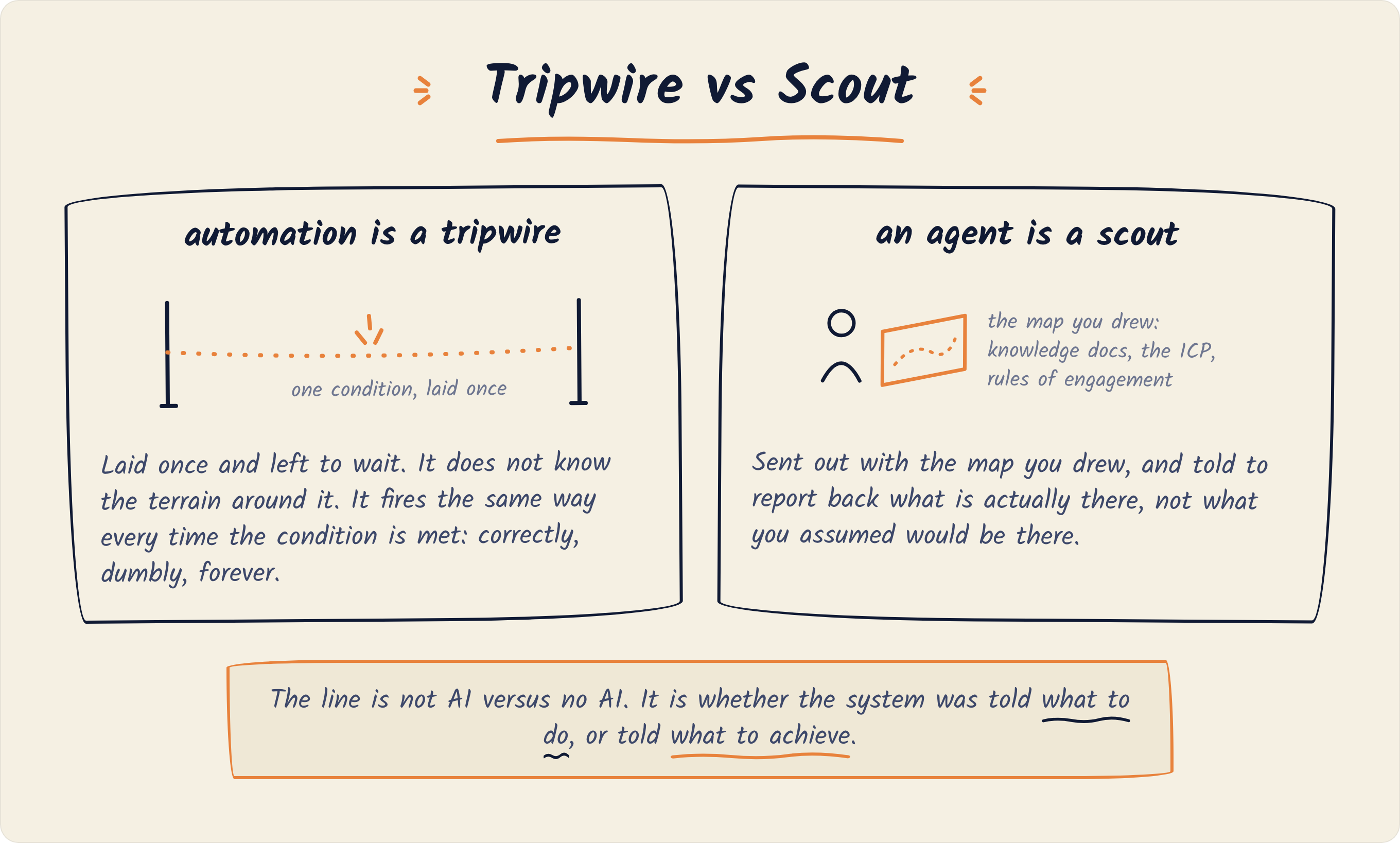
The line is whether the system was told what to do, or told what to achieve.
A trigger fires. A goal gets pursued. That is the whole difference between marketing automation and an AI marketing agent, and most of what gets sold to you as “AI-powered” this year blurs the two on purpose.
Automation runs a path you built in advance: when this happens, do that, in the order you specified, until you go back in and change it. An agent works from a goal and the judgment you gave it: find the account, weigh the evidence, decide whether it qualifies, and say so when the evidence does not add up cleanly. One executes a script. The other makes a call.
Your stack probably runs both right now. The question worth answering is whether you know which is which.
This one sits under AI marketing agents, and its whole job is to draw that line clean enough that everything else can build on it. Almost nobody searches this question, which is itself the finding. Forty people a month in the US type it, while the terms above it carry hundreds. The distinction is not what people go looking for. It is what they find out they needed after they have already built on the wrong side of it.
What is the difference between an agent and a trigger?
A trigger is a tripwire, laid once and left to wait. It does not know the terrain around it. It only knows the one condition it was set to catch, and it fires the same way every time that condition is met, correctly, dumbly, forever. An agent is closer to a scout, sent out with a map you drew (the knowledge docs, the ICP, the rules of engagement) and told to report back what is actually there, not what you assumed would be there.
That is what “agentic marketing” actually means when a vendor uses the phrase honestly. The system is not running your steps faster. It is reading your knowledge, applying your judgment, and making a call, the same kind of call a person on your team would make, at a pace that multiplies what one person could cover alone in a day. (What agentic marketing actually means goes deeper on where that judgment comes from.)
The line is not AI versus no AI. Plenty of automations now have a language model bolted into one step for drafting or summarizing, and that alone does not make them agents. The line is whether the system was told what to do, or told what to achieve.
What does each one look like in practice?
Take the same job, lead qualification, and look at how each side of the line does it. Here is qualification as automation, the points table most platforms sell:
Title contains VP or Director:      +10
Company size 50 to 500:             +5
Visited the pricing page:           +15
Opened three emails this month:     +5
Score over 25: route to sales
Every judgment in that table was made once, at setup, by whoever configured it. The system is not deciding anything on the day it runs. It is adding.
Here is the same job as an agent dispatch, condensed from the qualification pattern the working system behind this blog runs:
You are the qualifier. Read the ICP file and this account's activity history.
Decide whether the account fits, cite the evidence that convinced you, and say
how confident you are. If the fit is genuinely unclear, return it to a person
with the open question named instead of forcing a score.
Read those back to back and the difference stops being theoretical. The points table has no opinion, and was never asked for one. The dispatch is built to form one, to show its reasoning, and to hand the ball back to a person when the evidence will not support a clean answer. The first breaks silently when your market shifts under it. The second notices the shift, because noticing is the job it was given.
Which parts of my stack are automation, and which are agents?
Five things almost every marketing team already runs, sorted. None of them are the enemy here. Sorting them correctly is the whole point.
| What you run | Which side | Why |
|---|---|---|
| Email sequences | Automation | A fixed path of sends on a fixed cadence. Personalization tokens do not change the category; a mail merge with better manners is still a mail merge. |
| Social schedulers | Automation | You wrote the post, you picked the hour, the tool publishes it. That is correctly the whole job. |
| Lead scoring | Depends | A points table is automation wearing a spreadsheet. A model that reads activity against your actual ICP and explains its reasoning sits on the agent side. Check which one you bought. |
| A ChatGPT tab | Neither | No standing goal, no persistent knowledge, no memory past the tab. A sharp assistant running single-player. |
| A Zapier chain | Automation | Ten triggers linked in sequence are still ten triggers, each blind to everything except the one before it. Length does not change the category. |
The ChatGPT row deserves one more sentence, because it is where most teams actually stand. Give that same chat a brief that persists, a knowledge file, and a goal that outlives the conversation, and it starts becoming the thing this piece is describing. That gap, a persistent brief instead of a fresh prompt and a knowledge file instead of a blank tab, is most of the distance between “I already use AI” and “I have an agent.” The Marketing OS Blueprint at the end of this piece maps that structure.
Do I need automation, or agents?
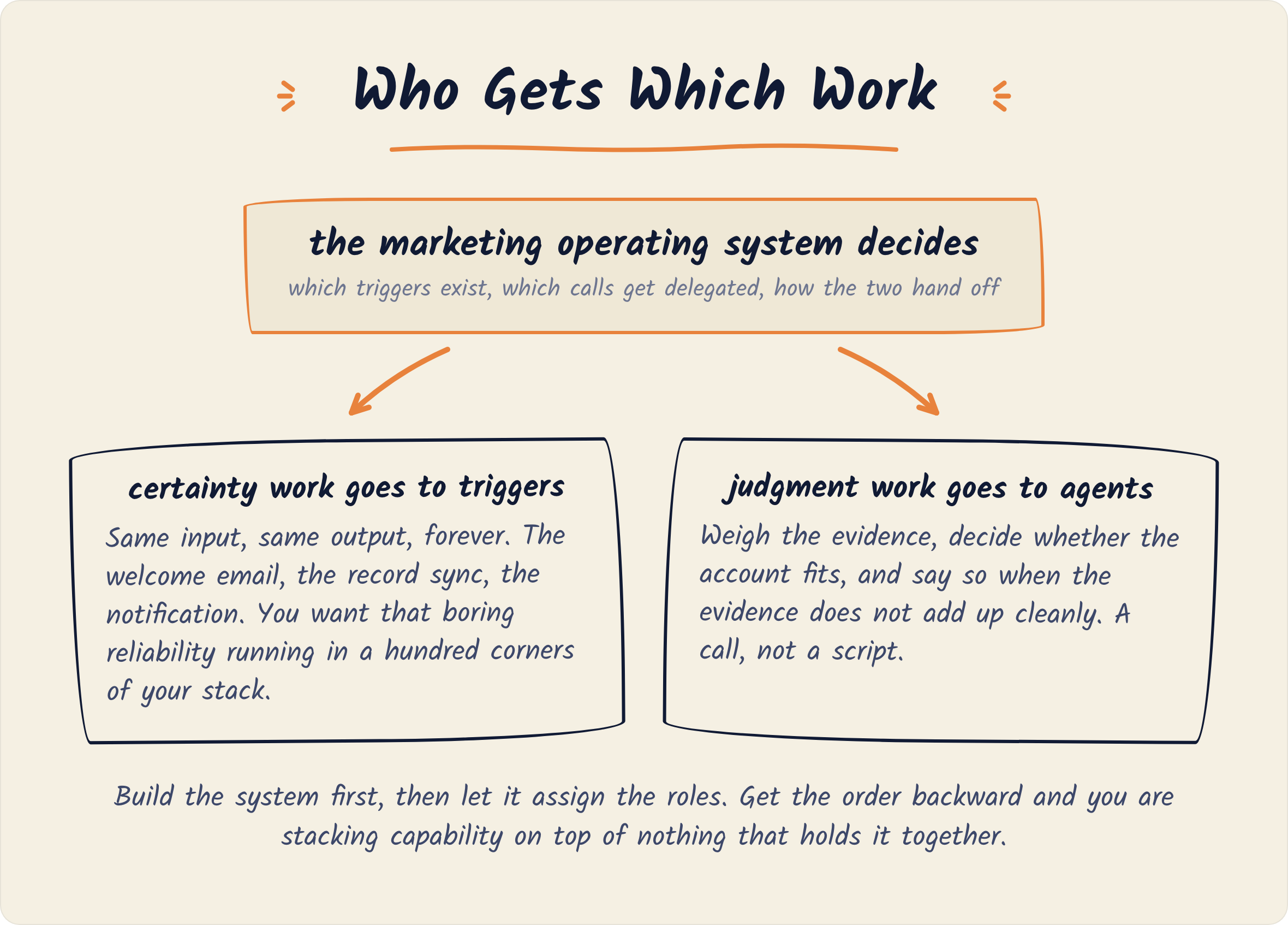
Both, and the order matters more than the mix. A trigger that reliably sends the welcome email is worth more to your business than an agent re-deciding, from scratch, every single time, whether a welcome email is warranted. Automation is the part of the system built for certainty: same input, same output, forever. You want that boring reliability running in a hundred corners of your stack.
The marketing operating system is the whole those parts sit inside of: the central point that decides which triggers exist, which judgment calls get delegated to an agent, and how the two hand off to each other without a person standing in the gap on every single occasion. Skip building that layer and you get what most “AI-powered” stacks actually are underneath the branding: automation, doing the same fixed work it always did, dressed up and running slightly faster.
Build the system first, then let it assign the roles: certainty work to triggers, judgment work to agents. Get that order backward and you are stacking capability on top of nothing that holds it together.
One more thing worth knowing, since it bears on everything above it: this piece was not written from a template and cleaned up by a person afterward. It came out of a dispatch working from a brief, a voice file, and a goal, the same shape as the second block above, running on the words you are reading right now. That is not a claim about the technology. It is a receipt.
Know which one you are running, in every corner of the stack, before you decide which one to build next.
The annotated file tree and starter structure from this piece ship as one document: the Marketing OS Blueprint.