AI Marketing Agents: What They Actually Do, and What They Cannot Do Alone

The human sets the standard, and the system multiplies it.
AI marketing agents are software workers you hand a job description, a set of files they are required to read, and a boundary they are not allowed to cross. Not a chatbot you prompt. Not a workflow you drag onto a canvas. An agent takes a charter, takes tools, does one piece of the work end to end, and passes the ball along to whoever comes next. On a marketing team that means four jobs: research that sweeps wide and returns evidence, strategy that decides and names the trade-off, creation that drafts against real brand files, and review that rejects. The part the vendor pages leave out is the important one. An agent cannot supply the point of view. That still comes from you.
Search “ai marketing agents” and you get one of two pages. A listicle of ten platforms somebody tested for an afternoon, or a vendor glossary that defines the category in the shape of the product it is selling. About 1,900 people a month in the US run that search, and advertisers pay roughly $23 a click to sit above the results (Google Ads, August 2026). Twenty three dollars a click means the answer to this question is being bought rather than earned, and what the buyer gets for the money is a feature grid. Nobody shows you the inside of a team that actually runs.
So that is what this is. The four roles below are the working roster of the system that produced this article, the site it sits on, and the film on the homepage. The charters are real files. The excerpts are lifted from them. And one distinction before you meet them, because it is the one the org-chart demos skip: four roles does not mean four agents. Two of these run isolated, in their own context windows, for reasons worth understanding. The other two are charters one working session loads and works through, the way an operator changes hats. If you want the category framing first, start with what agentic marketing actually is and come back.
Can AI agents do marketing?
They can do most of the execution and none of the deciding. An agent can sweep dozens of sources and return a digest with every claim cited, draft a page against your voice files, and reject its own team’s work for a claim with no evidence behind it. What it cannot do is know which of three defensible positions your company should stake, or feel that a paragraph has every fact right and no life in it. Execution moves into the system. Judgment stays with the operator, and gets more valuable as the execution gets cheaper.
What does an AI marketing agent actually do all day?
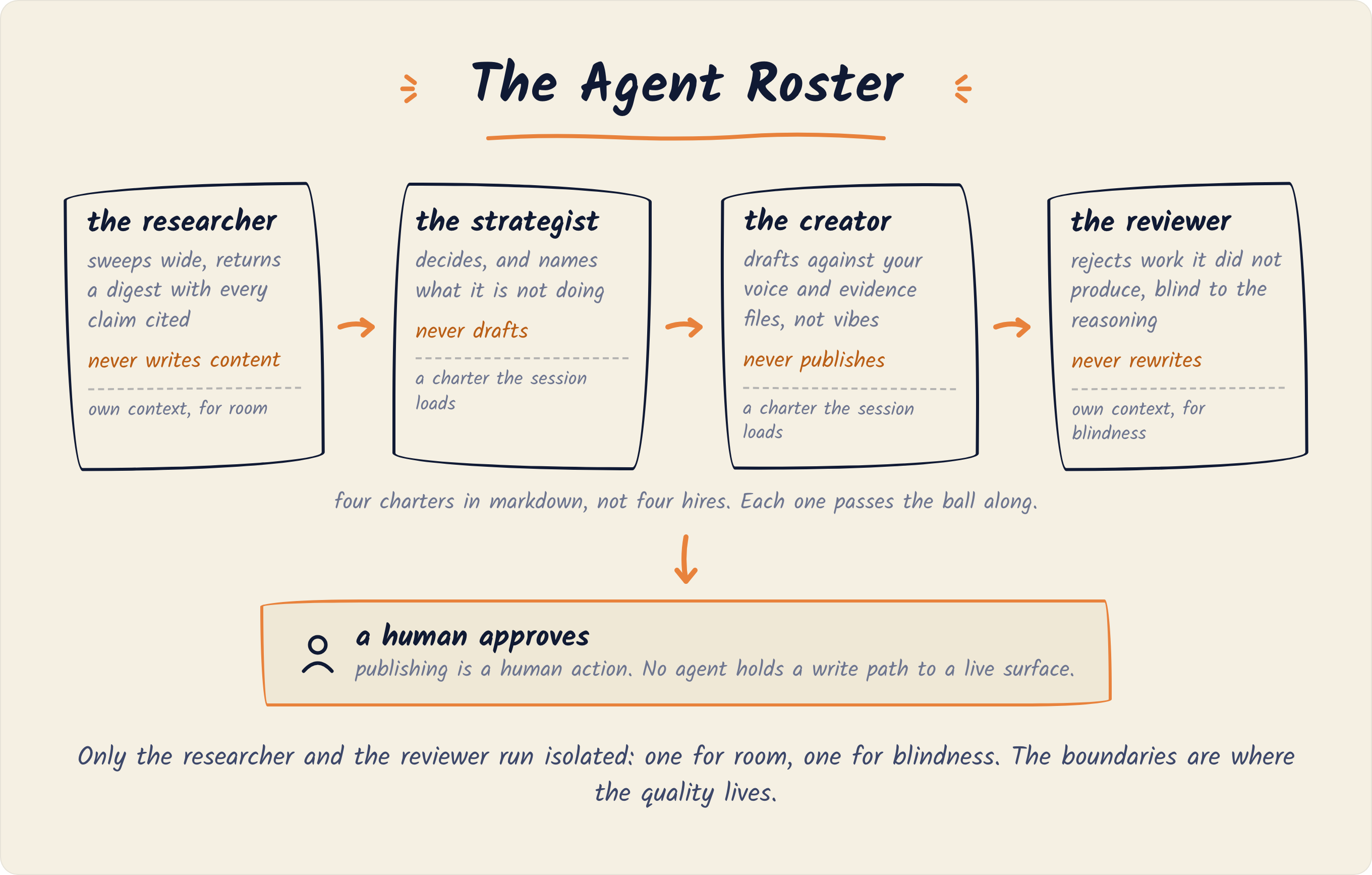
Here is the roster. Four charters, each a markdown file, each written the way you would write a job description for someone starting Monday: what you read, what you produce, what you never touch.
The researcher: sweeps wide, returns a digest
The research agent runs in its own context window with a high token budget, because a wide sweep produces pages of noise and the operator’s working context cannot absorb it. Its charter states the deal plainly: “operator hands off a research question, you spend your fresh context reading widely, and you return a digest.” Not a transcript. A digest.
The output contract is fixed and has six sections: the question restated, The One Insight, key findings, an evidence table carrying source and date and URL for every claim, what it could not see, and sweep metadata including why it stopped. The two rules that make it trustworthy are both refusals. First: “Never invents an insight to fill the slot.” The charter is explicit that “‘No actionable insight’ is a valid finding when the evidence supports it.” Second, and this is the one I would port into any system you build: “The ‘What I Can’t See’ section is mandatory and load-bearing.” Paywalled sources, stale corpus, a blocked region, a tool that timed out. The gaps surface where the reader can act on them instead of dissolving into a confident-sounding paragraph.
There is a token discipline written into the file too, roughly seventy percent of context for reading and thirty for synthesis, with instructions to stop the sweep and synthesize from what it has if it blows past. A partial digest with a marked gap beats a sweep that ran out of room mid-thought.
The mode-level research protocol adds two lines worth stealing. “Signal-first, not list-first,” which means start from who recently did something that indicates need and then qualify against the profile, rather than building a list and hunting for a reason to contact it. And “Verify and extend, not duplicate,” which sends the agent to check what the company already knows before it spends a dollar rediscovering it.
The researcher never writes content, never makes the strategic call, and never spawns helpers of its own. Its charter puts the last one memorably: “You are a leaf in the agent graph.”
The strategist: decides, and names what it is not doing
The strategy charter opens with a test, not a template. Every recommendation has to survive the inversion test: “would a smart person argue for the opposite? If not, it’s hygiene, not strategy.” That one line kills about half of what passes for a marketing plan. Post more on LinkedIn does not survive it. Nobody credible argues for posting less at random, so it is not a decision, it is a chore.
It thinks top down through three levels. Business outcome first: revenue, pipeline, market position, resource efficiency. Then the growth lever, and the charter lists each lever with its own inversion already written beside it, so new demand generation sits next to the note that a reasonable operator could instead pour everything into converting the pipeline they already have. Only then does it reach tactics. The discipline line: “Always trace a tactical recommendation back up to Level 2 (which lever?) and Level 1 (which outcome?)… If you can’t, the tactic is orphaned.”
Its output is a brief in Rumelt’s structure: situation, diagnosis, guiding policy, coherent actions, trade-offs, measurement, kill criteria. Two fields in that brief do more work than all the others combined. Exit criteria, which the charter requires to be “Specific, measurable. Defined BEFORE any asset is created.” And the minimum viable campaign, defined as the smallest set of assets that tests whether the angle works, not the maximum. Every planning pass also produces a stop-doing list alongside the start-doing list, because a strategy that only adds is a wish list.
The strategist reads brand config, prior research, and the lessons file. It does not go find its own evidence, and it does not write the asset. It decides what to do and why. The other roles decide how.
The creator: drafts against files, not vibes
The creator charter does not let drafting start until five questions have answers. Who is this for. What do they currently believe. What should they believe after. What is the single action, and the charter says it twice: “One CTA. Not two.” What proof do we have. On long-form work the answers get written into the file’s own frontmatter, which means the brief travels with the draft and the reviewer can check the work against the promise instead of against its own taste.
Then it loads the depth the task requires and nothing more. Voice guide for a social post. Voice plus evidence plus persona for an email. Voice plus evidence plus positioning for a blog post. All of it for a landing page. The charter has a name for what happens when you load more than that, and it is the most useful piece of vocabulary in the whole system: cognitive smearing. Research files loaded during drafting degrade the drafting. The fix is sequence, not capacity.
Its writing rules are the ones any good editor enforces. Simple over complex. Specific over vague, because “Numbers beat adjectives.” Active over passive. Customer words over marketing words. Then two tests that catch AI slop before it leaves the room. The competitor swap test: put a rival’s name on the draft, and if nothing breaks, the content is generic and gets rewritten. And the problem test, which asks whether the reader feels called out in the first thirty seconds: “Lead with their world, not yours.”
The creator writes the file to the right place and stops. It does not push anything live. Publishing is a human action in this system, deliberately.
The reviewer: rejects, and never grades its own homework
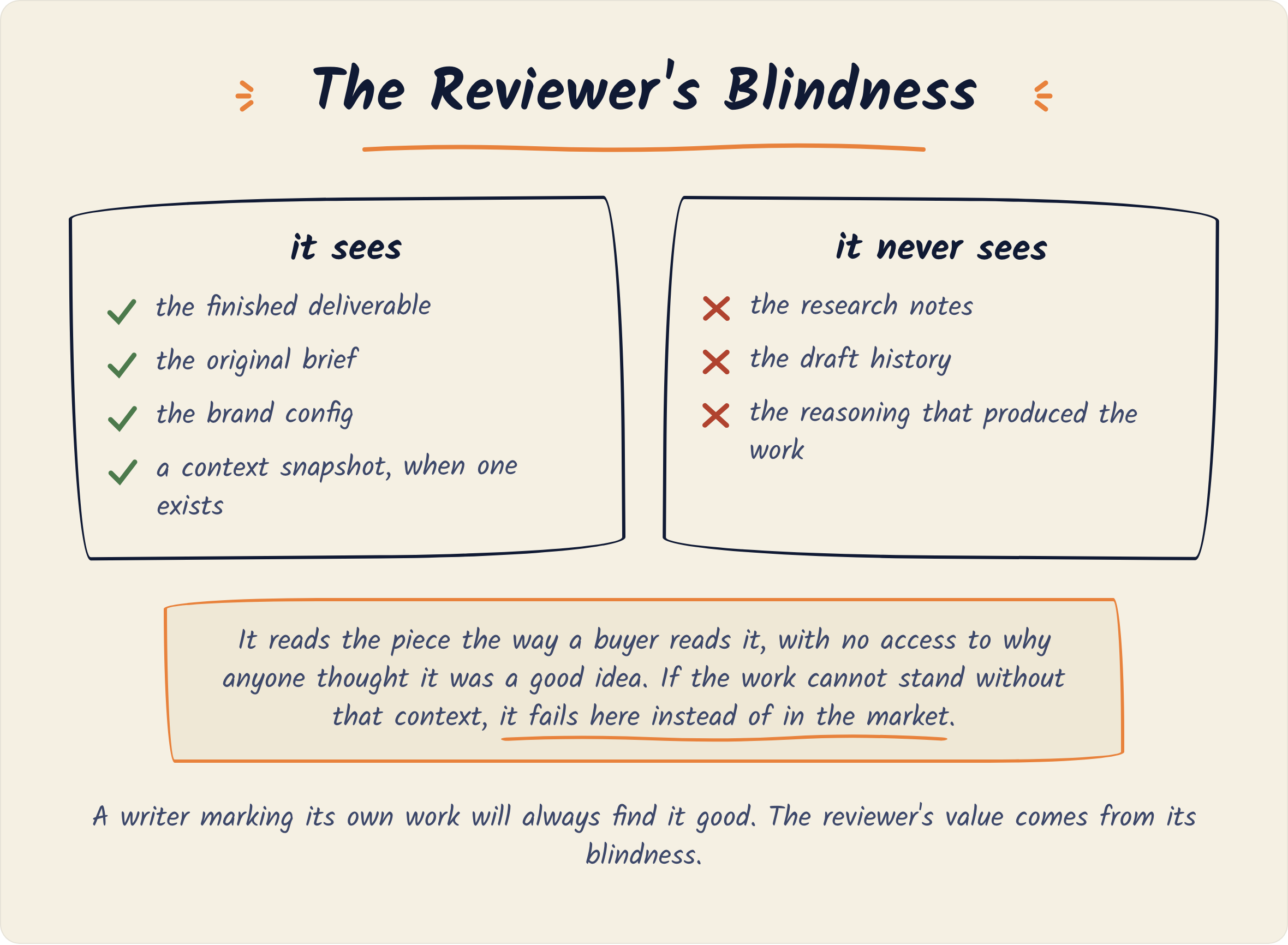
The review agent runs as a separate process with a separate context, and its charter says why in one line: “The Reviewer’s value comes from its blindness.”
It sees four things. The finished deliverable, the original brief, the brand config, and an optional context snapshot. It does not see the research notes, the draft history, the angle selection, or any of the reasoning that produced the work. It reads the piece the way a buyer reads it, with no access to why anyone thought it was a good idea. If the deliverable cannot stand up without that context, it fails, which is exactly what would have happened in the market.
The evaluation runs six layers: structural compliance, voice and anti-slop, a persona simulation, evidence verification, channel fit, and technical SEO for anything web-destined. Two of the creator’s own tests get run again here by someone who did not write the draft, which is the entire point of a gate.
The judgment that makes it usable rather than exhausting is the split between fixes and recommendations. A fix is objective, goes straight back for correction, and no human is involved. The test in the charter: “Would any competent editor make the same correction? If yes, it’s a FIX.” A banned word, a stat that does not match the evidence library, a broken heading hierarchy, a paragraph that contradicts the one three above it. A recommendation is subjective and does not trigger a revision. It goes into the report with the reviewer’s reasoning attached, and a human decides. The angle is technically correct but flat. The competitive framing is accurate but might provoke a response.
Two more guardrails. Feedback has to be specific enough to act on, so “‘The hook is weak’ is banned feedback.” And the fix loop is capped at two revision cycles, after which everything escalates to a person, because an agent pair that cannot converge in two passes has a problem no third pass will solve.
The reviewer has read tools and nothing else. No write, no edit, no shell, no integrations. Its charter: “It evaluates; it does not modify.”
What does each role read, produce, and never touch?
| Role | Reads | Produces | Never allowed to |
|---|---|---|---|
| Researcher | Open web, competitor sites, search data, existing internal intelligence | A digest: one insight, key findings, an evidence table with dates and sources, and an honest list of what it could not see | Write content. Make the call. Invent an insight to fill the slot. |
| Strategist | Brand config, prior research, the lessons file, the frameworks index | A brief: situation, diagnosis, guiding policy, actions, trade-offs, measurement, kill criteria | Run its own research. Draft the asset. Recommend something whose opposite no smart person would defend. |
| Creator | Voice files, evidence library, persona file, the approved brief | The draft, in the right location, with the brief written into its own frontmatter | Load research or QA material while drafting. Publish. Make a claim with no source. |
| Reviewer | The finished draft, the brief, the brand config. Nothing else. | A verdict per layer with cited violations, split into objective fixes and human-decision recommendations | See the draft history or the reasoning. Rewrite the work. Grade its own homework. |
Read the last column again. The boundaries are where the quality lives. Any one of these four could technically do all four jobs, and the output would be worse every time, because a writer marking its own work will always find it good and a researcher with an opinion will always find evidence for it. The separation is not bureaucracy. It is the mechanism.
Do four roles need four agents?
No. Roles need charters. Only two of the four earn a context of their own, and the reasons are different in kind.
The researcher runs isolated for room. A wide sweep reads pages of noise to find one insight, and if that noise shares a context with the drafting, it degrades the drafting. So the sweep spends a fresh context and sends back a digest, and the working session never touches the raw material.
The reviewer runs isolated for blindness. It cannot grade the work honestly from inside the context that produced the work, because it would be reading the reasoning instead of the piece. Isolation is not an implementation detail there. It is the entire value.
The strategist and the creator are charters the same working session loads in sequence, one hat at a time, with rules about what may be in context while each hat is on. No handoff, no swarm, nothing new to maintain.
I watch teams build the opposite: an agent for every task, a roster that looks like an org chart, a demo that looks like a company. It demos beautifully and degrades in production, because every agent-to-agent handoff loses context you did not know was load-bearing, and every standing agent is software somebody now maintains. Separation is not free. Buy it exactly where it pays, room for research and blindness for review, and chain everything else as playbooks inside one session.
Why does the review gate matter more than the model?
Because the model is the same one everybody else has. What separates a system that produces pro grade work from a system that produces slop at volume is whether anything in the pipeline is allowed to say no.
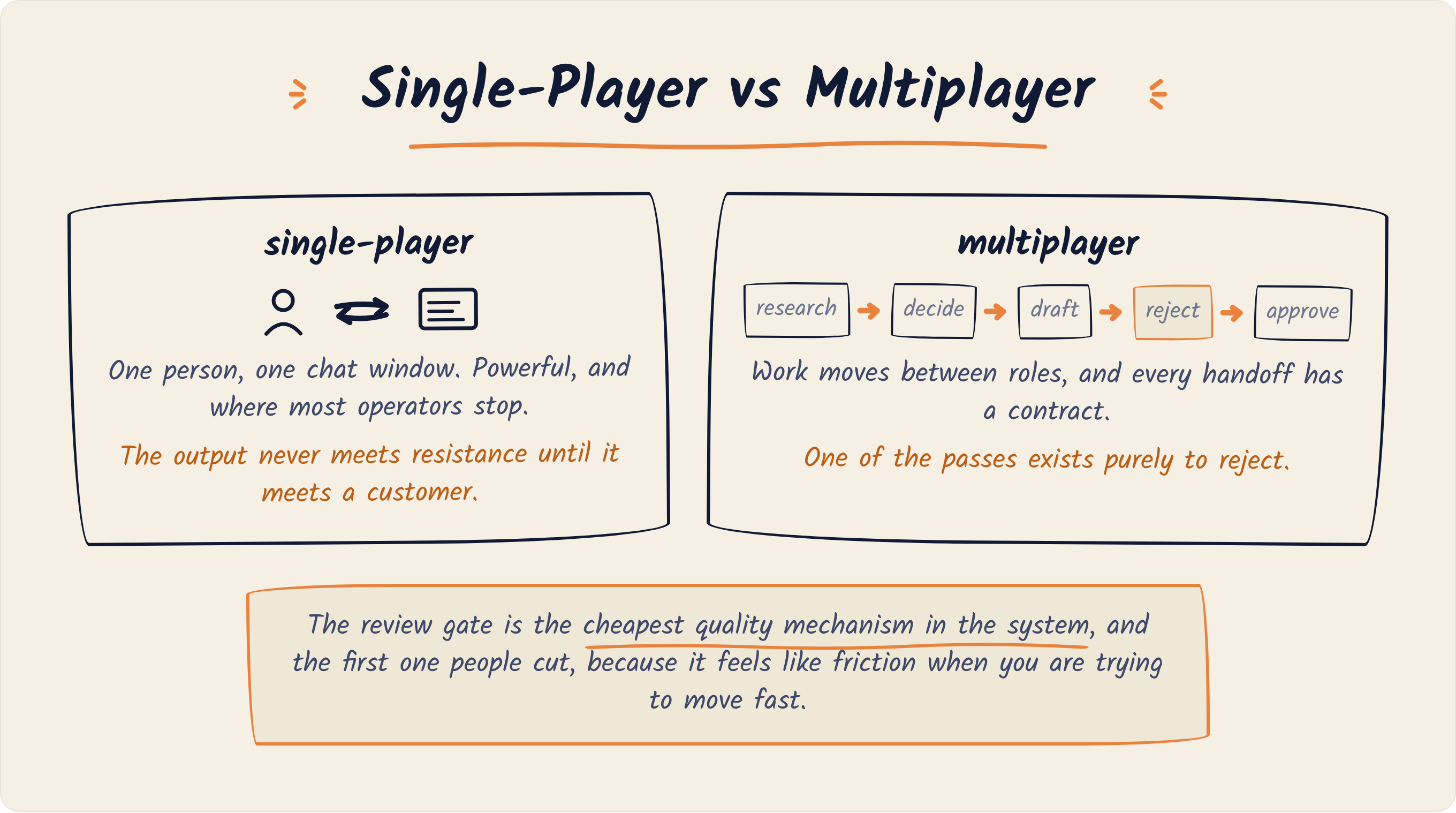
Single-player AI is powerful, and most operators stop there. One person, one chat window, output that never meets resistance until it meets a customer. Multiplayer is the actual game: work moves between roles, every handoff has a contract, and one of the passes exists purely to reject. The review gate is the cheapest quality mechanism in the system and the first one people cut, because it feels like friction when you are trying to move fast. It is the grit at the end that makes the work real. It is also the difference between agents that help you and agents that flood you, which is the whole substance of agents versus marketing automation.
Which AI agent is best for marketing?
This question is a category error, and it is the most common one in the results. Asking which agent is best for marketing is like asking which employee is best for marketing. Best at what: reading a hundred sources without editorializing, or rejecting a draft for one unsourced claim? Those are opposite temperaments, and no single agent does both well.
Roles beat brands. Define the four jobs first, decide what runs each one second, and the platform question mostly answers itself. A tool that gives you one general assistant with a chat box cannot express the separation above, so the quality has nowhere to come from. A tool that lets you write distinct charters with distinct file access and distinct refusals can, whichever vendor’s name is on it. The charters in this article are markdown. They would run on top of several different engines, because the roster is the asset and the engine is the rental. That is the difference between buying agents and owning a marketing operating system.
How much do AI agents cost?
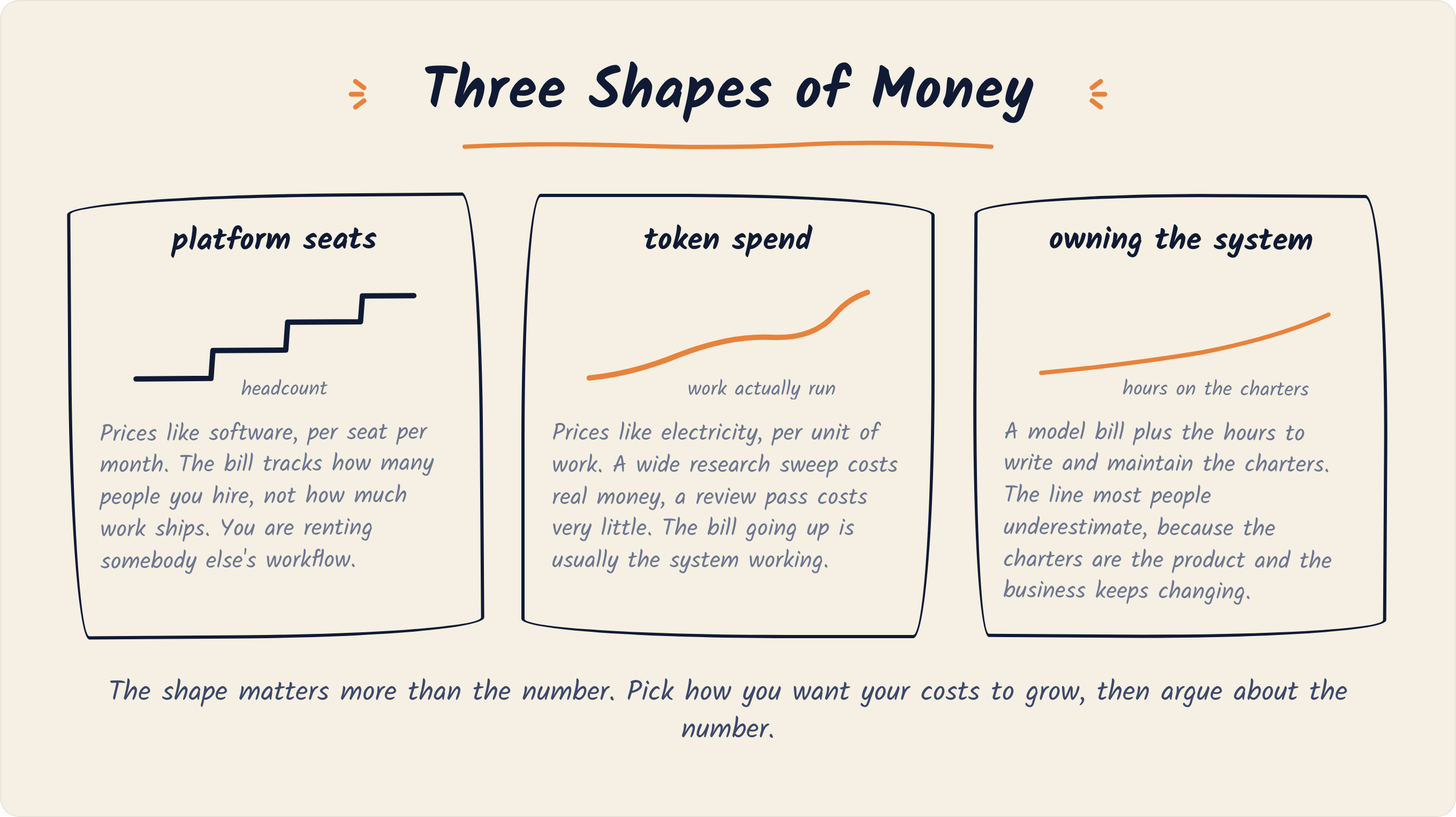
Three shapes of money, and they behave differently. Platform seats price like software, per seat per month, so the bill tracks your headcount rather than your output and you are renting somebody else’s workflow. Token spend prices like electricity, per unit of work, so a wide research sweep costs real money, a review pass costs very little, and the number goes up when the system is actually working. Owning the system costs a model subscription or an API bill plus the hours to write and maintain the charters, which is the line most people underestimate, because the charters are the product and they need revision every time the business changes.
The honest answer is that the shape matters more than the number. Seats scale with how many people you hire. Tokens scale with how much work you actually run, which means the bill going up is usually the system working. Owned charters cost hours that come back every time the business changes. Pick the shape that matches how you want your costs to grow, and then argue about the number.
What AI marketing agents cannot do alone
Everything above is execution, and execution is the part becoming a commodity. Here is what stayed on your side of the line.
The point of view. An agent can produce five defensible positions and rank them. It cannot know which one your company should stake, because that answer lives in what you have seen in the market, what a customer said last week in words nobody wrote down, and what you are willing to be wrong about in public. The inversion test is a filter, not a source. Something has to go into it.
The taste. A draft can pass six layers of review and still be dead on the page. Correct is not the same as alive, and the gap between them is the entire craft. No agent on that roster can feel a paragraph go flat. The reviewer is built knowing this about itself, which is why the recommendation category exists at all: it flags the issue, writes its reasoning, and hands it to a person, because two smart editors would disagree and the tie gets broken by somebody with a stake in the outcome.
The proof. Agents can cite what exists. They cannot generate a customer result, and the fastest way to destroy a marketing system is to let one invent proof that sounds plausible. Everything that carries weight in a market, the deployment that worked, the number you actually hit, the sentence a buyer said back to you, comes from operating a real business. That is why the evidence library is a human-maintained file the agents read and never write.
The permission to speak for the brand. Somebody has to be accountable for what goes out. In this system, publishing is a human action, and no agent holds a write path to a live surface. That is not caution. It is the recognition that a brand is a promise a company makes, and a promise needs somebody who can be held to it.
Which lands the whole thing in one line. The human sets the standard, and the system multiplies it. Once execution becomes a commodity, the standard is the only scarce input left, and an agent roster is an amplifier that does not care what it is amplifying. Point it at a sharp point of view and it carries your best thinking to every surface your buyer touches. Point it at a vague one and it will produce vague work faster than any team you could hire.
Where an operator actually starts
Not with a platform trial. With one charter.
Pick the role on your team whose work most often comes back for a rewrite, and write down three things: what that role reads before it starts, what it produces, and what it is never allowed to do. That third list is the hard one, and it is where the quality comes from. Then run a single piece of work through it and watch what the boundaries catch. Every charter behind this system is a markdown file, and the whole roster is readable in an afternoon. If you want to see the system they run inside, the walkthrough is 45 minutes on a working one.
The bottleneck was never the making. An agent roster removes it, and the moment it does, the thing standing between you and the market stops being capacity. It becomes whether you have anything worth multiplying. That is a better problem than the one you had. It is also a harder one, and I do not think most teams have noticed yet that they traded one for the other.
The annotated file tree and starter structure from this piece ship as one document: the Marketing OS Blueprint.