What Is a Marketing Operating System? A Plain-English Guide

Your standards do not fail because people stopped caring. They fail because nothing holds them in place.
A marketing operating system is one place your company keeps everything its marketing needs to know and everything it needs to do: your positioning, your brand, your buyers, your proof, your playbooks, and the agents that execute them. It lives in a repository your company owns, rather than spread across the tools you rent by the seat. You change your positioning once, and every piece of work that comes after it carries the change.
That is the definition. The more useful question is why a company would need one, so let me start there.
What problem does a marketing operating system solve?
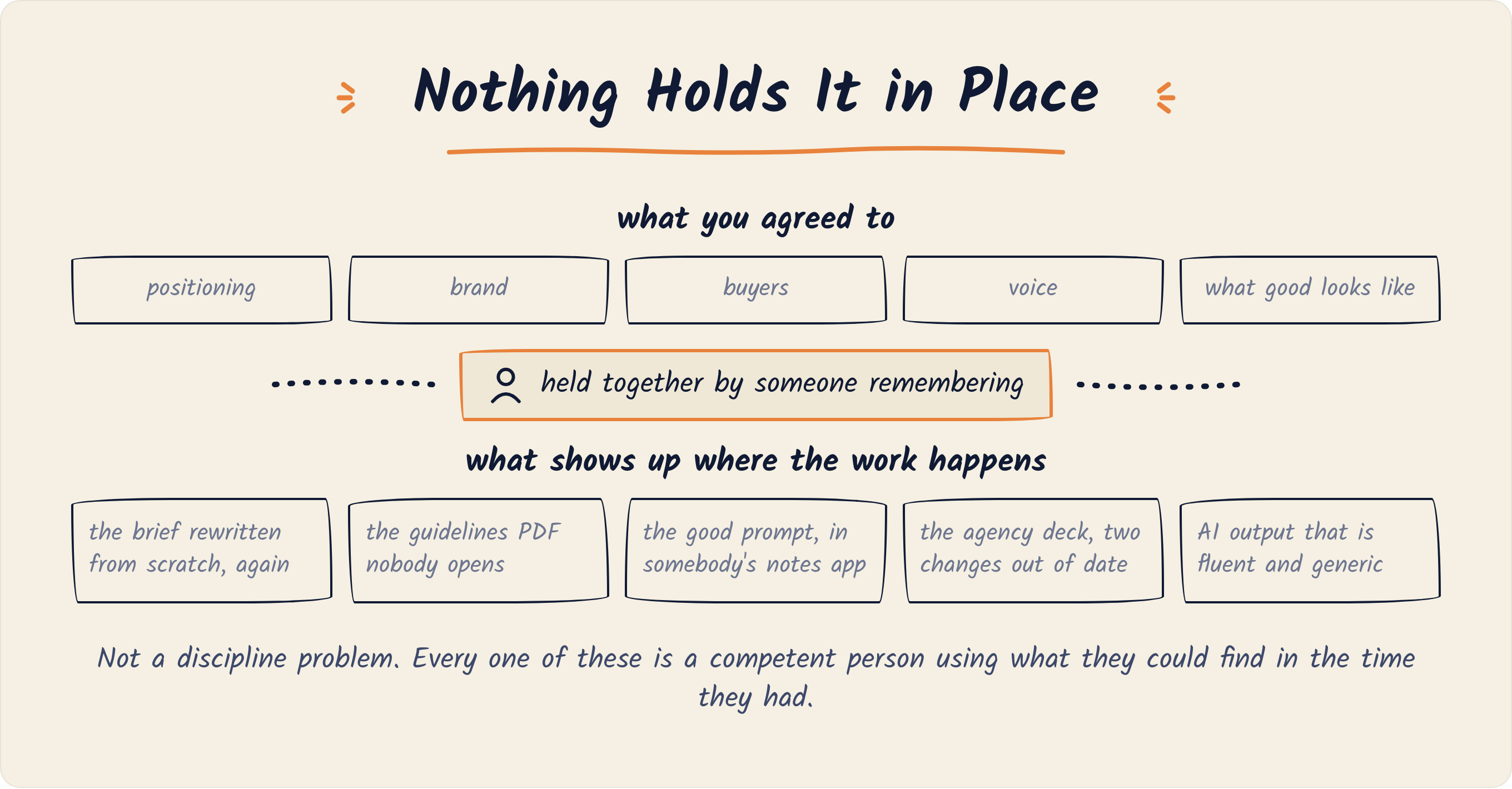
It solves this one: the marketing standards you worked hardest to build are the ones least likely to survive contact with the work. You already have positioning. You have a brand, a buyer definition, a sense of what good looks like, and you probably paid real money to write some of it down. Then Monday happens, and almost none of it is present in the room where the work actually gets made.
You know the shape of this even if you have never named it.
The brief gets rewritten from scratch every quarter, because finding last quarter’s takes longer than starting over. The brand guidelines exist as a PDF nobody opens. The prompt that finally produced good copy lives in somebody’s notes app. The agency is working from a deck that is two positioning changes out of date, and nobody told them, because nobody knew they had to. The AI writes something fluent, technically correct, and unmistakably generic, because the only thing anyone gave it was a prompt.
None of that is a discipline problem, which is the part worth sitting with. Every one of those is a competent person doing their job with the material they could find in the time they had. The structure did not fail because people stopped caring about it. It failed because nothing was holding it in place.
That is the gap. You agreed to a level of structure, you try to hold it together by hand, and holding it together by hand is enormously hard. When it slips, everything downstream slips with it, quietly, and usually you find out one campaign too late.
What you actually want is an environment where the principles and strategies you worked so hard to create still hold when you go do the work. Today, for most teams, that is not what happens.
Why doesn’t it hold on its own?
Because the thing holding it together is a person remembering, and no tool in your stack has that job. Carrying context from one system to the next is real labor that appears on no org chart, has no owner, and shows up in the budget only as the work it silently slows down.
It shows up as a new hire spending their first month learning what the brand sounds like, from people, in meetings. It shows up as a freelancer producing something plausible and off-key, then a round of edits nobody can quite articulate. It shows up as an AI given a prompt and no knowledge, answering exactly as well as it was equipped to.
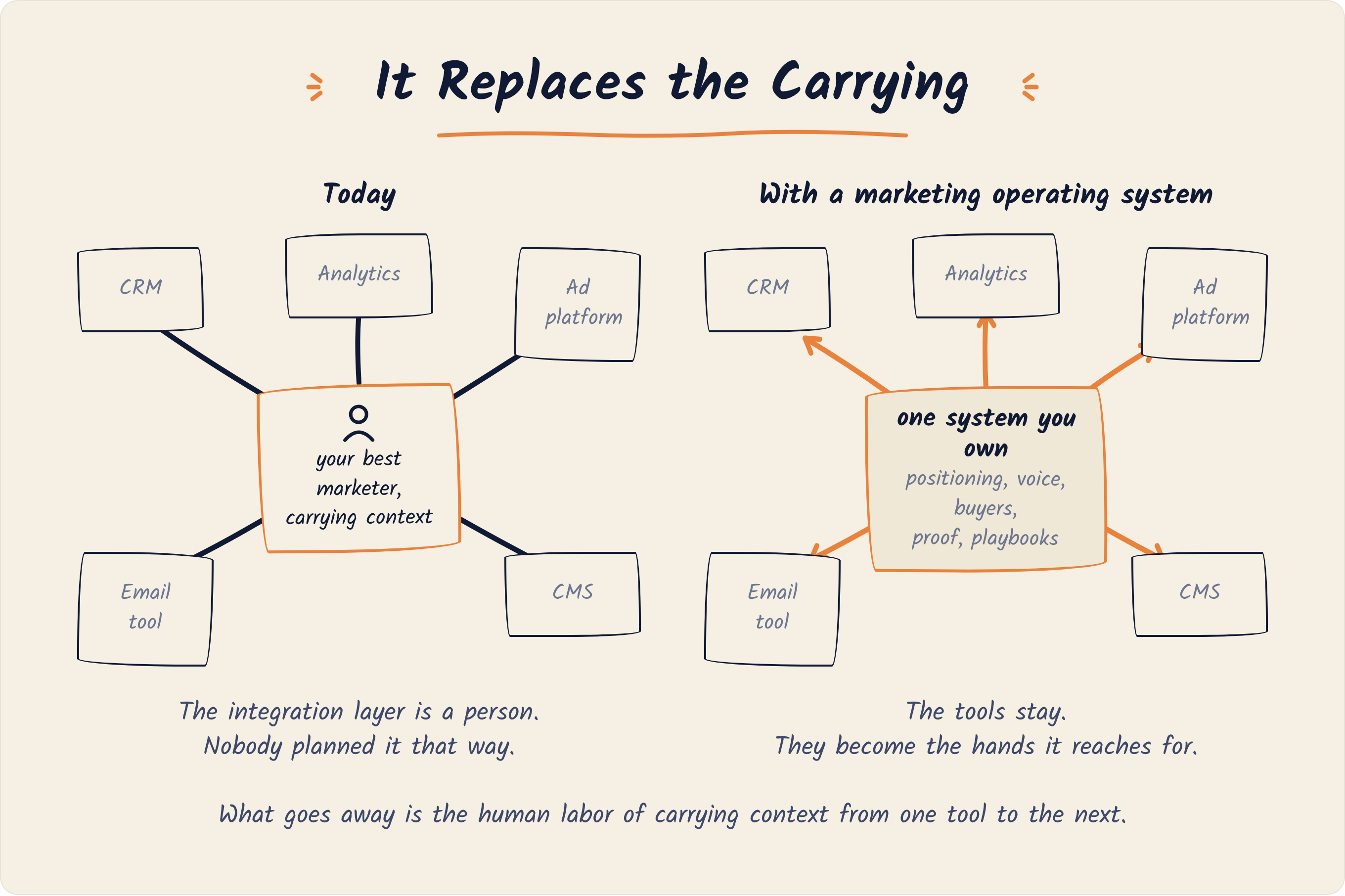
The person doing most of that carrying is usually your best marketer. They are the integration layer, and nobody planned it that way. If they take another job, the machine stops, and you would not be able to say precisely which part broke.
What does a marketing operating system actually hold?
Three things, and it fails if it is missing any one of them.
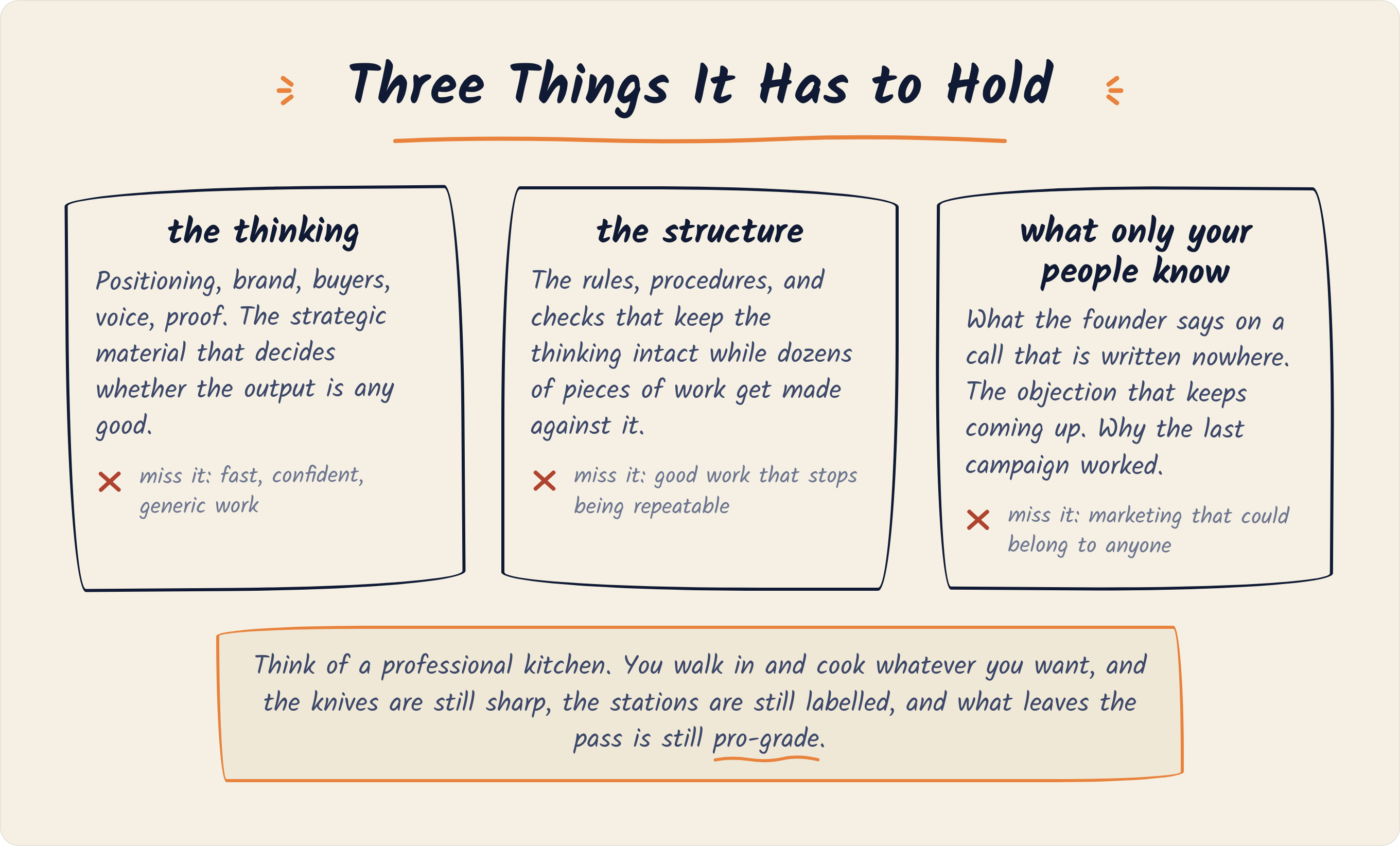
The thinking. Positioning, brand, buyers, voice, proof. The strategic material that determines whether the output is any good. Most of what gets called an AI marketing problem is a missing version of this.
The structure. The rules, the procedures, and the checks that keep the thinking intact while dozens of pieces of work get made against it. This is the half almost nobody builds, and it is the half that makes the other two survive.
What only your people know. The thing the founder says on a sales call that is not written anywhere. The objection that keeps coming up. The reason the last campaign actually worked. If you cannot get that into the system, you will produce work that is well made and slightly beside the point.
The useful mental picture is a professional kitchen. You can walk in and cook whatever you want, which is the freedom part. The knives are sharp, the stations are labeled, and what leaves the pass is still pro-grade, which is the structure part. Nobody experiences the structure as a constraint, and every plate is better because it is there.
Miss the thinking and you get fast, confident, generic work. Miss the structure and you get good work that stops being reproducible the moment the volume goes up. Miss what your people know and you get marketing that could belong to any company in your category.
What does it replace?
It replaces the carrying, not the tools. Your ad platform stays. Your CRM stays. Your email tool stays. What goes away is the human labor of moving context from one of them to the next, and the quiet decay that happens when that labor gets skipped.
Concretely, it replaces the brief you rewrite from scratch every quarter, the guidelines nobody opens, the prompt library in somebody’s notes app, and the institutional knowledge that walks out the door when a person leaves.
What it does not replace is judgment. It cannot tell you what your company should stand for, or which buyer is worth chasing this quarter. It holds that decision once you have made it, and then makes sure the work that follows is an expression of it. The decision stays yours. The carrying does not.
Is it the same as marketing automation?
No. Automation executes a sequence you designed in advance, and a marketing operating system holds the judgment behind the sequence: the positioning it expresses, the reason it exists, and the agents that can produce genuinely new work rather than only route existing work.
The difference is easiest to see the day your positioning shifts. In an automation platform, that means opening every template, every branch, and every subject line by hand, which is why most teams do it partially and then stop. In an operating system, the positioning lives in one file, and every session that runs after you edit it reads the new version.
I have written a longer piece on where AI agents and automation actually diverge. The short version is that automation is deterministic and an operating system is generative under governance.
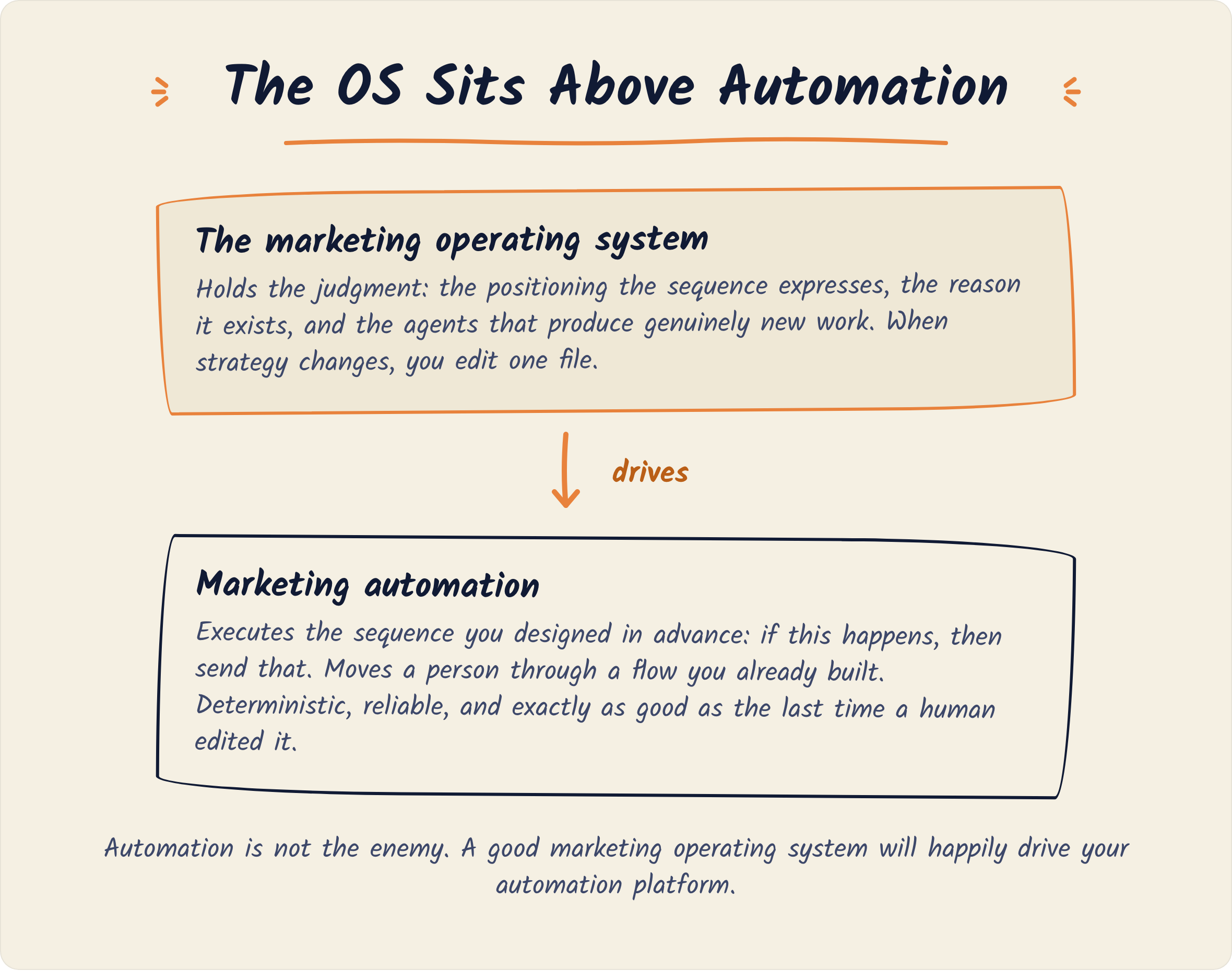
Automation is not the enemy here. A good marketing operating system will happily drive your automation platform. It sits above it, holding the reason the sequence exists in the first place.
Is it the same as a martech stack?
No, and the distinction is ownership. A martech stack is a set of vendors you rent, each holding a slice of your knowledge inside its own database, none of them able to see the others. A marketing operating system is one thing you install and own, and the stack becomes a set of hands it can reach for.
Marketing ops tools sit in a third lane and get confused with this constantly. Customer data platforms, reverse ETL, workflow routers, and integration middleware move data between systems cleanly, and that work is real and worth paying for. It is also opinion-free. A pipe has no view on what your brand should sound like.
Which is the actual gap. The stack executes, the ops layer connects, and nothing in either one holds the strategic material that makes the output good.
| Point tools | Marketing automation | Marketing ops tools | A marketing operating system | |
|---|---|---|---|---|
| What it holds | One function’s settings, plus a copy of your data | Lists, contacts, and the branches of a flow you built earlier | Pipes, schemas, and routing rules between systems | Positioning, brand, buyers, voice, proof, playbooks, and the work itself |
| What it produces | An artifact trapped inside its own walls | Sends and scores against rules you wrote in the past | Clean movement of data, and no marketing output at all | Finished work in your voice: pages, campaigns, briefs, film, design |
| What happens when your positioning changes | You update it in that tool, if you remember that tool exists | You rewrite every template and every branch by hand | Nothing, it has no opinion about what you say | You edit one file, and every session after it reads the new truth |
| Who owns it | The vendor, priced per seat | The vendor, priced per contact | The vendor, priced per event | You, installed in your business, no seat licenses |
What does one actually look like?
It looks like a directory on a computer. Below is the real structure of the system behind this site. It is a folder you can open, read, and change, which is the point: a system you cannot inspect is a vendor relationship with better branding.
marketing-os/
├── CLAUDE.md              how the system works, read by every session
├── GOVERNANCE.md          what lives where, and who decides
├── brands/
│   └── yourbrand/brand.yaml     positioning, voice, audiences, in one file
├── knowledge-base/        the deep truth: positioning, buyers, proof
├── .claude/
│   ├── skills/            the playbooks: workflows the system executes
│   ├── agents/            the roles: researcher, strategist, creator, QA
│   └── rules/             guardrails loaded into every working session
├── content/               what the system produces, findable again
├── web-assets/            the website, built and shipped from inside
├── tokens/                the design system: color and type from one file
└── tasks/                 briefs in, work tracked, lessons kept
Four things in that tree are doing the heavy lifting. None of them are about the model.
The knowledge is distilled, not dumped
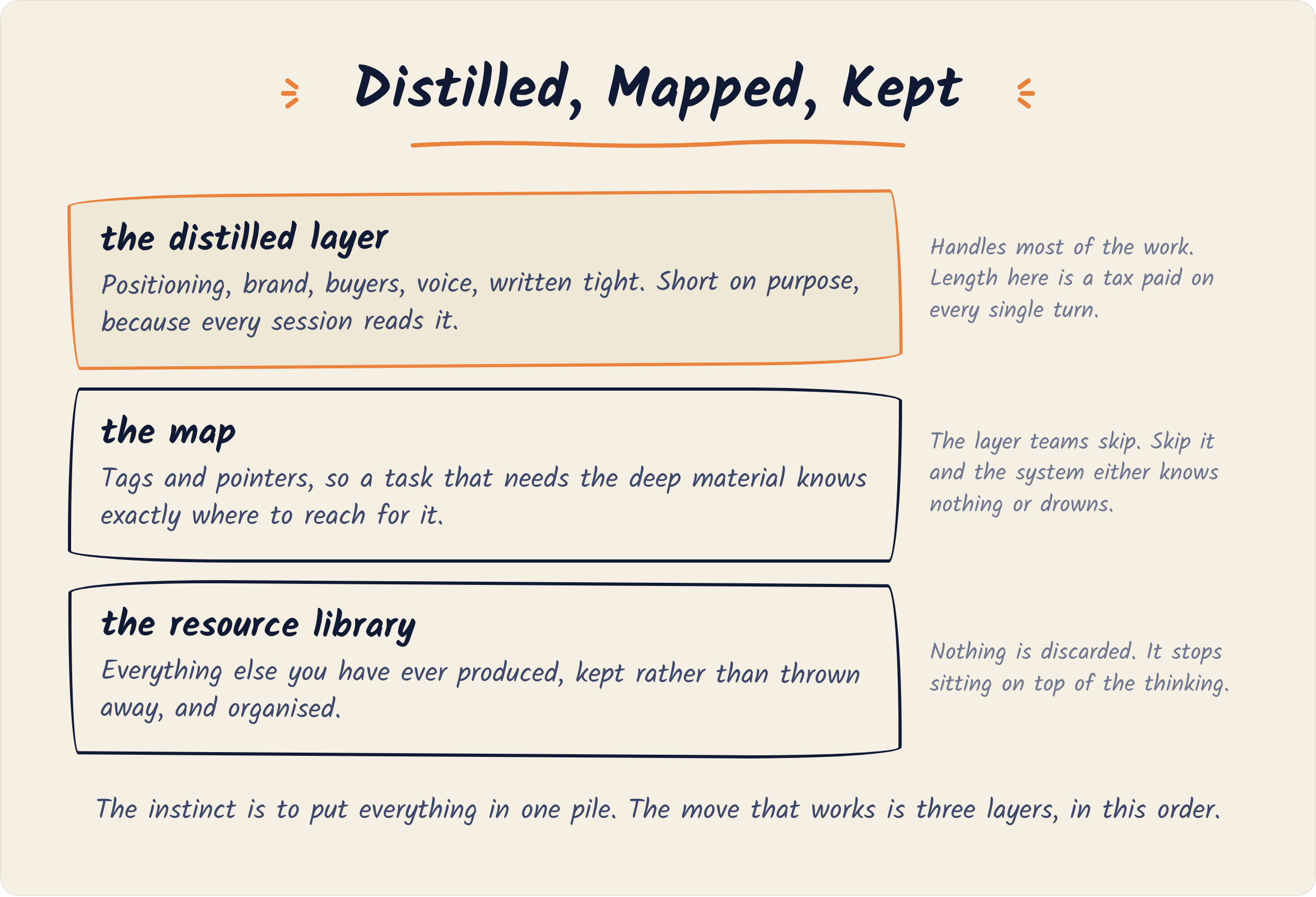
The instinct is to put everything in. The correct move is three layers.
On top sits a short, distilled strategic layer: positioning, brand, buyers, voice, written tight. This handles most of the work, and it is short on purpose, because every session reads it and length is a tax paid on every single turn. Underneath sits the resource library, which is everything else you have ever produced, kept rather than thrown away. Between them sits a map, so that when a task does need the deep material, the system knows exactly where to reach.
Teams skip the middle layer and then wonder why the system either knows nothing or drowns.
Knowledge loads first, and in order
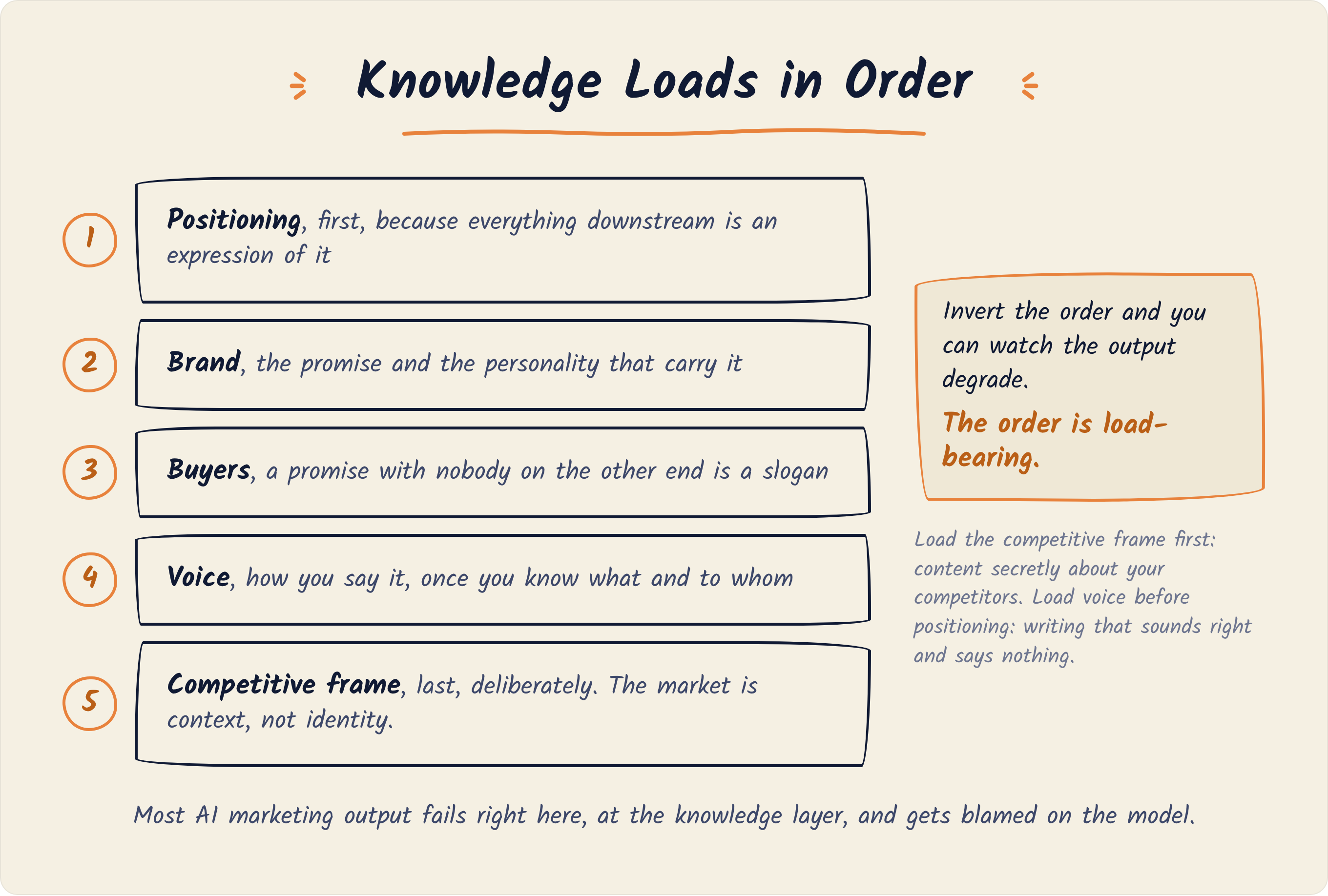
The knowledge base loads before any work begins, in a fixed sequence: positioning, then brand, then buyers, then voice, then the competitive frame. Positioning comes first because everything downstream is an expression of it. Voice comes fourth, because how you say something only means anything once you know what you are saying and to whom. The competitive frame comes last, deliberately, because the market is context and not identity.
Invert that order and you can watch the output degrade. Load the competitive frame first and you get content that is secretly about your competitors. Load voice before positioning and you get writing that sounds exactly right and says nothing.
Something has to keep it in shape
This is the part almost nobody builds, and it is the part that decides whether any of the rest survives.
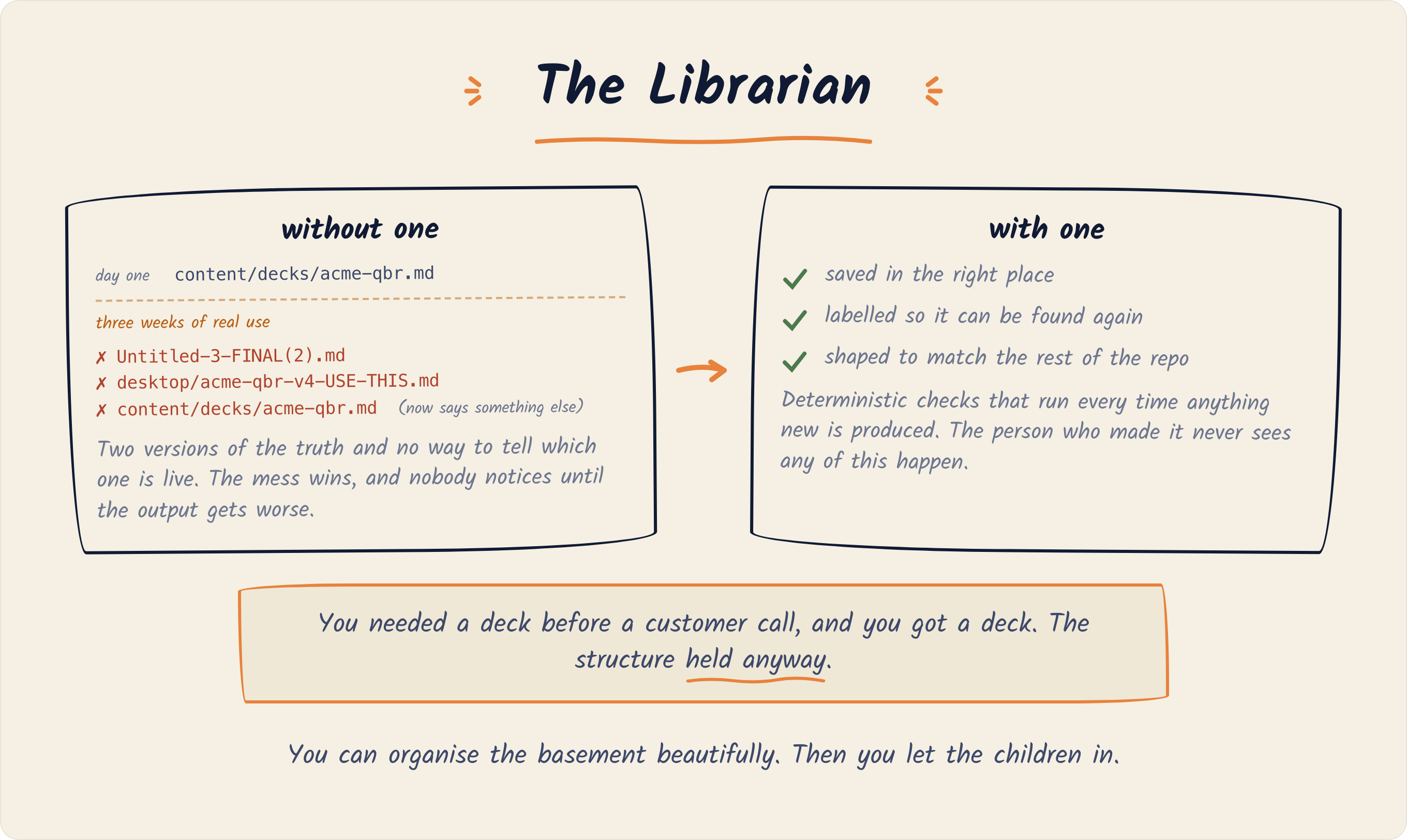
You can organize the basement beautifully. Then you let the children in. Teams spend three months building a knowledge base, and within about three weeks of real use it has been quietly rearranged: things renamed, work saved in the wrong folder, two versions of the truth, a file updated that should not have been. The mess wins, and nobody notices until the output gets worse.
So the system needs a librarian: a set of deterministic checks that run whenever anything new is produced, and put it in the right place, with the right labels, in the right shape. The person who made the thing does not have to know any of that happened. They needed a deck before a customer call, and they got a deck. The structure held anyway, in the background, without asking them to care.
That is the whole difference between a knowledge base that decays and one that compounds. Scope creep and file sprawl behave like a slow illness in these systems, and the only reliable cure is automatic rather than remembered.
Playbooks, not prompts
A prompt is a sentence somebody retypes and slowly degrades. A playbook is a file that says how a piece of work is done: what to load, in what order, what good looks like, what to refuse, and when to stop and ask a human.
The consequence is that quality standards accumulate instead of evaporating. When the bar for a landing page changes, it changes in one file, and every landing page built after that inherits it. Nobody has to remember, because remembering was never part of the design.
Change it once, and it changes everywhere
The tokens directory is the clearest demonstration. Color, type, spacing, and rhythm live in one file. The website reads it. The slide template reads it. The video compositions read it. Change a brand color there and it propagates to every surface, including the surfaces that do not exist yet.
That property is the reason to build this way, and it has almost nothing to do with artificial intelligence. A marketing operating system is a single source of truth with executable procedures attached to it. AI is what lets those procedures run without a person sitting in every seat. This is the mechanic underneath what agentic marketing means in practice, and it is why the same architecture holds whether you have four people or forty.
The roles that work inside it are their own subject, and I have taken the roster apart separately in AI marketing agents.
Do you own it, or are you renting it?
You own it. A marketing operating system is installed in your business the way accounting software used to be: files on your machines, in your version control, under your accounts. There are no seat licenses, because there are no seats. You meter the models you call the way you meter electricity, and the system itself is an asset that sits with you.
Every tool in a normal stack is a rental agreement on your own knowledge. You pour your positioning, your buyer research, your best-performing copy, and your hard-won judgment into somebody else’s database, and the terms of that arrangement only become clear at renewal. When you leave, your knowledge does not come with you in any usable form. You get a CSV.
Now run the other scenario. Your vendor gets acquired, sunsets the product you built on, or arrives at renewal with a number that makes your CFO ask what changed. Your brand’s brain stays exactly where it is, on disk, fully readable, ready for whatever you point at it next.
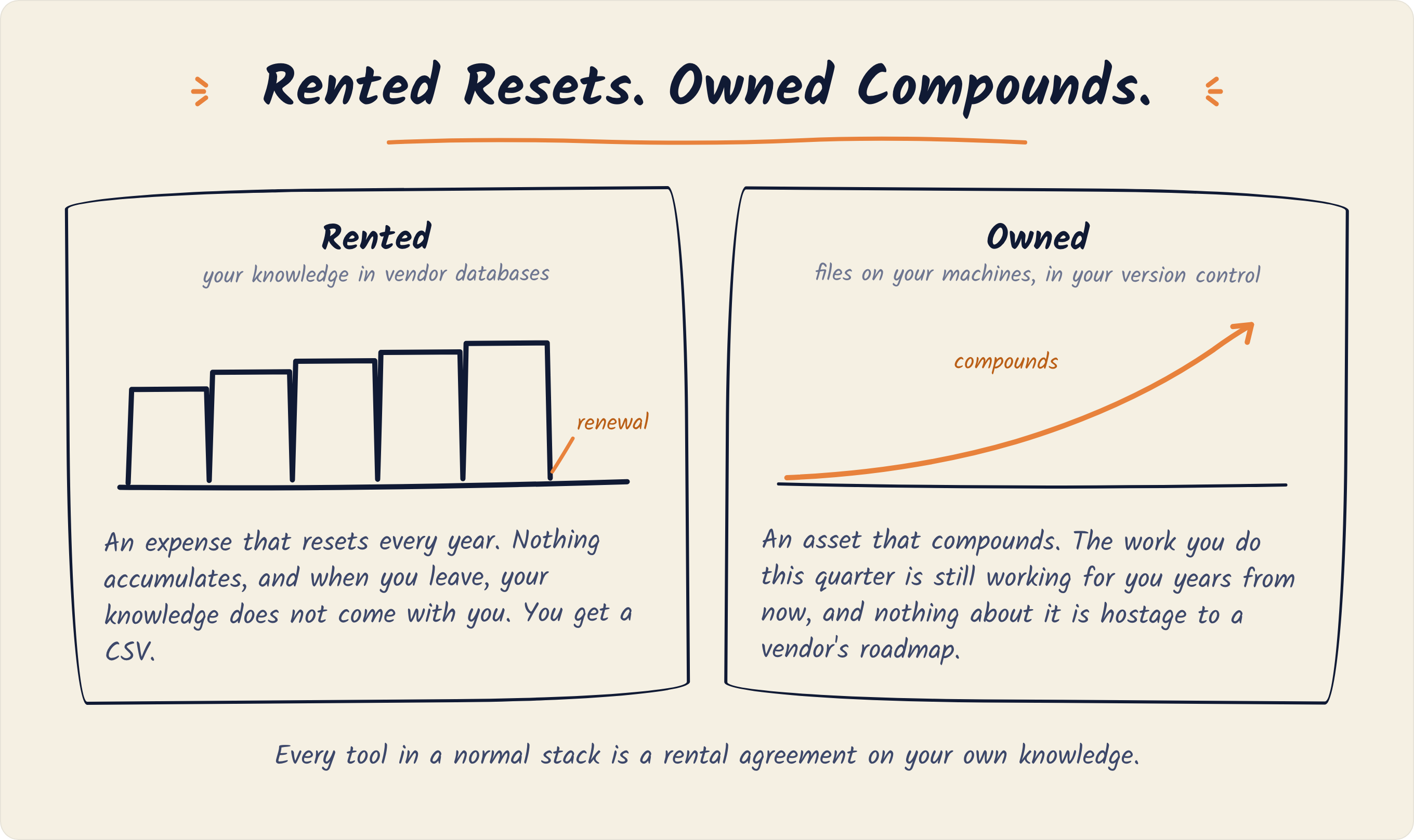
That is the economic wedge, and it is bigger than the software line item. Rented, your marketing knowledge is an expense that resets every year. Owned, it is an asset that compounds.
How do you know you need one?
You need one when your bottleneck has moved from deciding to shipping. If you already know your positioning, you already know which campaign should run next, you already know what good looks like, and the only thing between you and the work is that nothing executes without you personally carrying context into every tool and every brief, that gap is exactly what this closes. If you do not yet know what you are saying and to whom, this will produce more of the wrong thing, faster.
Five signals, and most operators will recognize at least three.
You explain your positioning more than once a month, to a new tool, a new hire, or a new agency, and every explanation comes out slightly different.
Your AI output is accurate, fluent, and unmistakably generic. The model did nothing wrong. It was given a prompt and no knowledge.
A positioning change takes a full quarter to reach every surface, and you can name at least one surface where it never arrived. That page is still selling the old company.
Your best marketer is the integration layer. If they left tomorrow, the machine stops, and you could not say which part broke.
You cannot narrate your own stack. If describing how a lead gets from your website to a meeting takes four open tabs, you are maintaining a junk drawer with a monthly invoice attached.
There is an honest version of the opposite answer. If you are one person with one channel and one message, you do not need this. You need to write, and you need to talk to buyers. This starts paying when the number of surfaces exceeds the number of people who can hold the whole story in their heads, which for most companies arrives around the first real marketing hire.
Where do you start?
Start with the knowledge, not the tooling. Open one file and write your positioning in plain language, the way you would explain it to a smart person who does not work for you. Then write who it is for. Then write how you sound, with two examples of what you would never say. Nothing about AI yet, and no software to buy.
That single file will immediately improve every tool you already own, because the reason your AI output reads as generic is that nobody ever told it the truth about your business. Then add the second file. Then write a playbook for the one piece of work your team redoes from scratch every time. The system accretes from there. It is not a purchase, it is a practice, and the first useful version of it fits on one page. When you want to see the whole thing assembled, the install walkthrough is the next stop.
I spent most of my career being the person who knew where the ship needed to go and then waiting on somebody else to steer it. The agency, the RevOps queue, the roadmap, the next sprint. What changed is not that AI got smart enough to do that work for me. What changed is that the distance between knowing and shipping collapsed for anyone willing to write the knowing down in a form a system can read.
One note on where this came from, now that you have the whole picture. This article was produced inside the system it describes, on the same rails as the film on the homepage and the design system that styles both. I mention it at the end rather than the top because the argument should stand on its own first. Everything above is the actual architecture, not a diagram of one.
That is the multiplication, and it is available to you this week. Once execution becomes a commodity, strategic thinking and brand building become everything. The operating system is where you put the thinking, so the execution finally has something to be about.
If you would rather see a working system than build one from an article, that is what the walkthrough is for.
Book a walkthrough