What Is Agentic Marketing? The Difference Between Automation and Agency

Vagueness in equals slop out. Precision in equals work that carries your fingerprints at a scale you could not have staffed.
Agentic marketing is marketing run by AI agents that are given a goal, the context to pursue it, and the judgment to decide how. An agent reads your positioning, your ideal customer profile, and your standards, then plans its own steps toward the outcome you asked for and returns work with the evidence behind it. That is the whole difference from marketing automation, which fires a fixed sequence of steps whenever a trigger fires. Automation knows what to do. An agent knows what you are trying to accomplish. One follows a path you drew in advance. The other finds a path, and tells you when the path you assumed does not exist.
Everything else written about this term is elaboration on that one distinction, and most of it is written by companies selling a platform. I want to give you the version an operator can actually use, because the practical question is not what the category means. It is whether agency is something you buy or something you install.
Advertisers are paying roughly fifty dollars a click on the search term “agentic marketing,” according to Google Ads data as of August 2026. That price tells you the people typing those two words have budget and a decision in front of them, and it also tells you who is funding the answers they find.
Is agentic marketing the same as marketing automation?
No. Automation fires a fixed sequence when a condition is met. An agent is given an outcome and decides its own steps toward it, which means automation can only do what somebody already thought of, and an agent can handle the case nobody previewed. The difference is visible in the actual instructions each one receives, so here are both, real patterns rather than diagrams.
Here is automation. Anyone who has built a workflow in the last fifteen years has written this:
WHEN a form is submitted
  THEN add a row to the sheet
  THEN send the welcome email
  THEN notify the channel
Here is an agent dispatch, sanitized from a system that runs every week:
You are the researcher.

Read brand.yaml and the ICP file.
Find accounts showing the buying signal defined in signals.md,
qualify each against the ICP, and return a ranked list with the evidence.

If the signal is ambiguous, say so rather than forcing a match.
Read the second one again, slowly, because four things are happening in it that never happen in the first one.
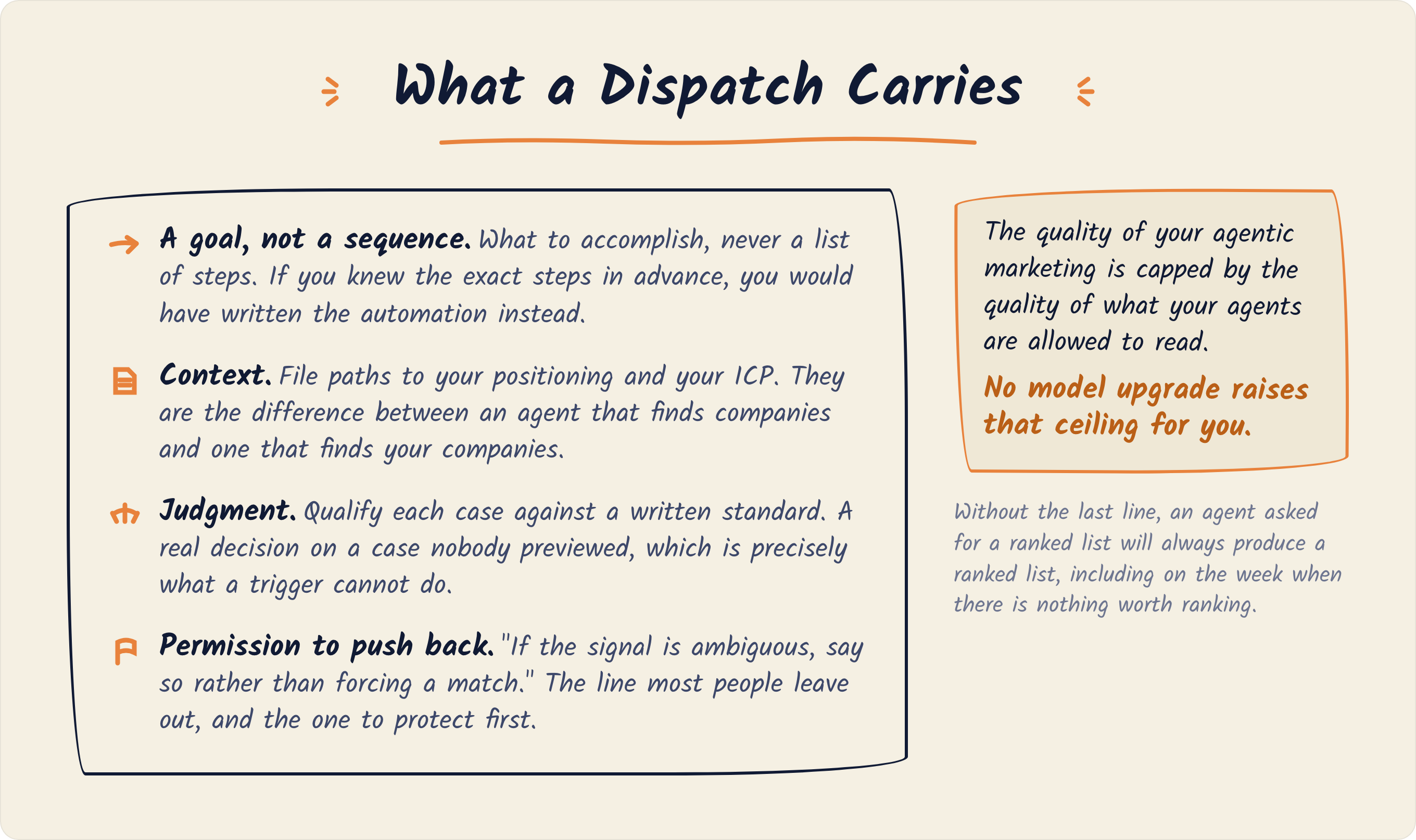
It carries a goal, not a sequence. The first block says what to do. The second block says what to accomplish: a ranked list of qualified accounts with evidence attached. How the agent gets there is not specified, because it cannot be. The right search on Monday is not the right search on Thursday, and if you had known the exact steps in advance you would have written the automation instead.
It carries context. Two file paths, brand.yaml and the ICP file, are doing enormous work in that dispatch. They are the difference between an agent that finds companies and an agent that finds your companies. Without them, the agent will produce something confident and generic, which is the thing everybody complains about when they complain about AI output. Those files are load-bearing. The quality of your agentic marketing is capped by the quality of what your agents are allowed to read, and no model upgrade raises that ceiling for you.
It carries judgment. “Qualify each against the ICP” is a real decision, made once per account, on a case that nobody previewed. The agent is being asked to compare a specific messy company against a written standard and take a position. That is the actual work of a good analyst, and it is precisely what a trigger cannot do, because a trigger has no concept of better or worse. It only has true and false.
It carries permission to push back. The last line is the one most people leave out, and it is the one I would protect first. “If the signal is ambiguous, say so rather than forcing a match” gives the agent a way to fail honestly. Without that line, an agent asked for a ranked list will always produce a ranked list, including on the week when there is nothing worth ranking. You will get ten accounts and no signal, dressed as ten accounts with signal. Then a human spends a day chasing them and quietly stops trusting the system.
That permission is not a safety feature. It is the thing that makes the output worth reading.
Here is the same comparison in one view.
| Automation | An agent | |
|---|---|---|
| What starts it | A trigger. Something happened, so the sequence fires. | An objective. Someone needs an outcome, so a goal is dispatched. |
| What it knows | The fields in the payload. | Your positioning, your buyer, your standards, and whatever it reads on the way. |
| What it produces | The same output every time the same input arrives. | A judgment, with the reasoning and evidence attached. |
| When reality surprises it | It runs anyway, or it errors. There is no third option. | It adapts, or it tells you the assumption broke. |
| What improves over time | Nothing, until a human rewrites the workflow. | The context files, which every future run reads. |
That last row is the one operators underrate. In an automation, improvement means someone opens the builder and edits the branch logic, so the system is exactly as good as the last time a person had a free afternoon. In an agentic system, improvement means someone sharpens a sentence in a knowledge file, and every agent that reads that file gets better on the next run. You are not maintaining workflows. You are maintaining a brain, and the compounding is real. I have gone deeper on that split in AI agents vs marketing automation, because the failure modes are different too, and the way you debug them is completely different.
None of this makes automation bad. I run plenty of it. When the steps genuinely never change, a trigger is the correct tool and an agent is an expensive way to be less reliable. Route the form fill. Sync the record. Post the notification. The mistake is not using automation. The mistake is believing that a longer chain of triggers eventually becomes judgment. It never does. It becomes a longer chain.
What does an agentic marketing system actually do?
An agentic marketing system holds three things and puts them in front of every agent on every run: your goals, your knowledge, and your standards. Goals are the outcomes the work is for, not the tasks. Knowledge is your positioning, your buyer, your voice, and the competitive frame. Standards are what clears the bar and who decides. Miss one of the three and the system produces confident noise.
Think about what you hand a strong new hire in their first week.
You do not hand them a flowchart. You tell them what you are trying to win, you point them at the documents that explain how this company thinks, you tell them what good looks like and what you will not ship, and you tell them to come back when something does not add up. Then you let them work. Six weeks later they are useful in ways you never specified, because they understood the goal well enough to handle the cases you forgot to describe.
An agentic marketing system is that briefing, written down, and given to software.
Your goals. Not tasks. The outcome the work is for. “Find accounts showing this buying signal and qualify them” is a goal. “Search LinkedIn for these three job titles” is a task, and the moment the right move is a fourth title, a task-shaped instruction has already failed.
Your knowledge. Positioning, buyer definition, voice, the competitive frame, the things you have learned that are not written anywhere else yet. This is the layer everyone skips, and skipping it is the single largest cause of output that sounds like everyone else. The order and specificity of these files determines the ceiling on everything the system makes. Get this wrong and no amount of prompting rescues it.
Your standards. What clears the bar, what gets sent back, and who decides. A system with goals and knowledge but no standards will ship the average of everything it has read, which is a definition of forgettable. Standards are where taste enters the machine, and taste is still yours.
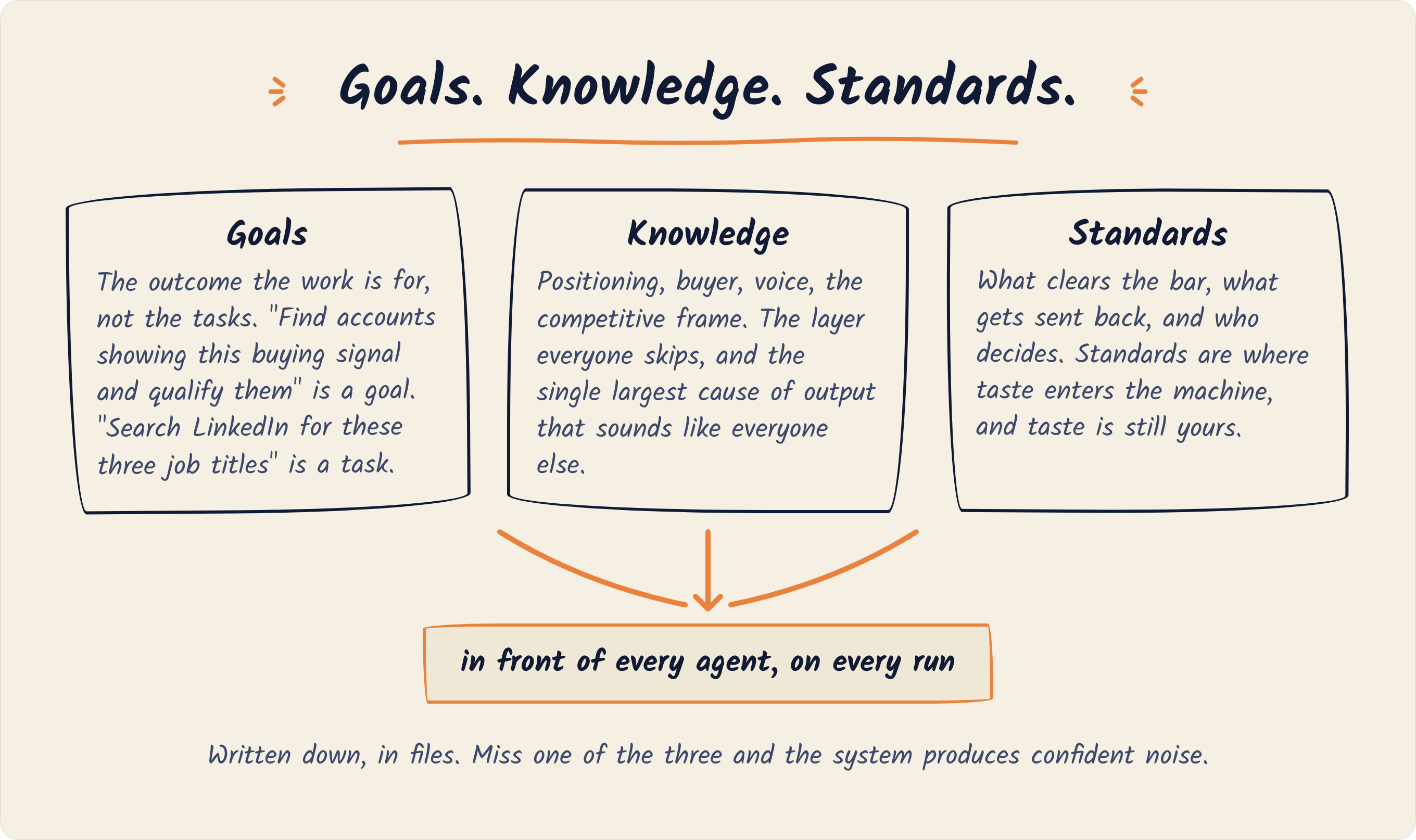
Goals, knowledge, standards. Written down, in files, that agents read on every run. That is the whole architecture, and it is why I keep saying agency is a property of a system rather than a feature on a product page. Individual agents are the visible part, and there is real craft in scoping them well, which is its own subject and one I have taken apart separately in AI marketing agents. But an agent with no knowledge anchor behind it is a very fast way to produce material nobody wanted. The container matters more than the agent, and the container is the thing almost nobody sells you, because it is made of your own thinking. That container has a name and a shape, and it is worth understanding on its own terms: a marketing operating system.
Do you need an enterprise platform for it?
No. You can buy agentic capability inside a suite, and for some teams that is the right call, but the goals it holds are the ones the product has fields for and the knowledge it reads is what fits the schema. Installing it yourself costs writing rather than engineering. Here is the honest version of both, including what the second one costs you.
The platform version is straightforward. You buy a suite, agentic capability arrives as a set of features inside it, and the vendor handles the hard parts. That is a legitimate path. If your team has no appetite for building anything, if procurement is the constraint you actually live under, or if the work you need is close to what the vendor already shaped, buy it and get on with your life.
Understand what you are buying, though. You are buying agency that operates inside someone else’s model of how marketing works. The goals it can hold are the goals the product has fields for. The knowledge it can read is the knowledge that fits the schema. And the standards are largely the vendor’s, because the outputs are tuned to what works across their whole customer base, which is the definition of average. That is a reasonable trade when your work is close to average. It is a bad trade when your differentiation is the point.
The other path is that you install the system and own it. The goals are the ones you wrote. The knowledge files are yours, in your repository, in your words, versioned so you can see what changed and when. The standards are the ones you enforce, at gates you decided to put there. Nothing about this requires an engineering team, and I want to be precise about that, because the word “install” makes people picture a build. It is closer to writing an operating manual than writing software. If you can brief a contractor clearly, you can do this work.
What it does require is your thinking, up front, in writing. That is the real price, and it is not small. Most operators have never written down their positioning at the specificity an agent needs, because a human colleague fills gaps from context and an agent fills gaps from the internet. The first two weeks of this feel less like automation and more like being asked hard questions about your own business by something that will not accept a vague answer. That part is uncomfortable. It is also the part that produces the value, and I would not describe it any other way: the work is the writing, and the writing is the strategy you had been carrying around in your head.
I would rather tell you that plainly than sell you a weekend. The install page shows what standing one up inside a business looks like, including the four weeks it takes.
Here is the receipt, and it is the only proof I have that is worth anything: this article and the website it sits on were produced by the system described in it. Agents drafted, checked the draft against the voice files, flagged what did not clear the standard, and a human approved before anything shipped. Not because publishing an article is impressive, but because the pipeline that produced it is the same pipeline that runs the research, the outbound, and the campaign work. One system, many jobs, one set of knowledge files underneath all of it.
What agentic marketing does not do
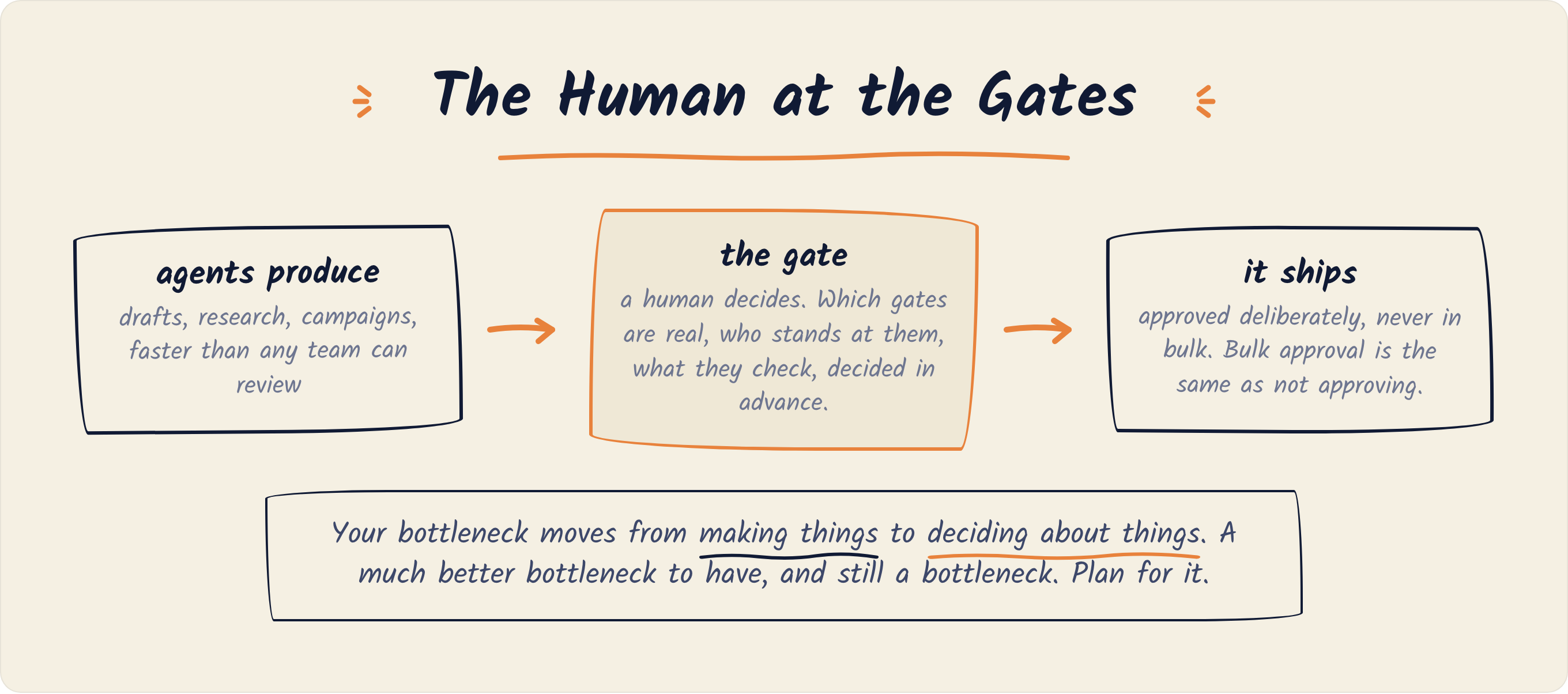
It does not remove you.
Every version of this that works has a human at the gates, and not as a formality. Agents produce faster than any team can review, which converts your bottleneck from making things into deciding about things. That is a much better bottleneck to have, and it is still a bottleneck. Plan for it. Decide in advance which gates are real, who stands at them, and what they are checking, or you will end up approving in bulk, which is the same as not approving.
It does not fix a strategy that was already wrong. An agentic system pointed at a weak position produces a great deal of well-executed weak positioning, and it does it quickly enough that you will notice the problem later than you should. Speed is not a correction mechanism.
And it does not make the work generic, which is the fear I hear most often from people who lead brands. The opposite happens, and this is the part I did not expect when I started. The more specific your knowledge files get, the less your output sounds like anyone else’s, because the system is reading your thinking rather than the internet’s average. Vagueness in equals slop out. Precision in equals work that carries your fingerprints at a scale you could not have staffed.
Which brings me to what I actually think the shift is.
The constraint on brand building was never the craft. It was the distance between having the thought and getting it deployed, with every handoff sanding the thought down a little more on its way to market.
Agentic marketing closes that gap. Not by making execution cheap, though it does. By making the thing you write down the thing that runs. Your positioning stops being a slide that gets referenced and becomes a file that gets read, on every task, by everything working on your behalf. Once execution becomes a commodity, the strategic thinking and the brand building become the entire game, because they are the only inputs left that are yours.
So the question worth sitting with is not whether to adopt agentic marketing. It is whether your thinking is written down clearly enough to be worth multiplying. Mine was not, when I started. Getting it there was the work.
If you would rather see a working system than build one from an article, that is what the walkthrough is for.
Book a walkthrough